Opening your first trading account is often a mix of excitement and anxiety.
Many beginners believe the hardest part is “getting started,” while in reality, early mistakes can cost months of learning or a significant portion of capital.
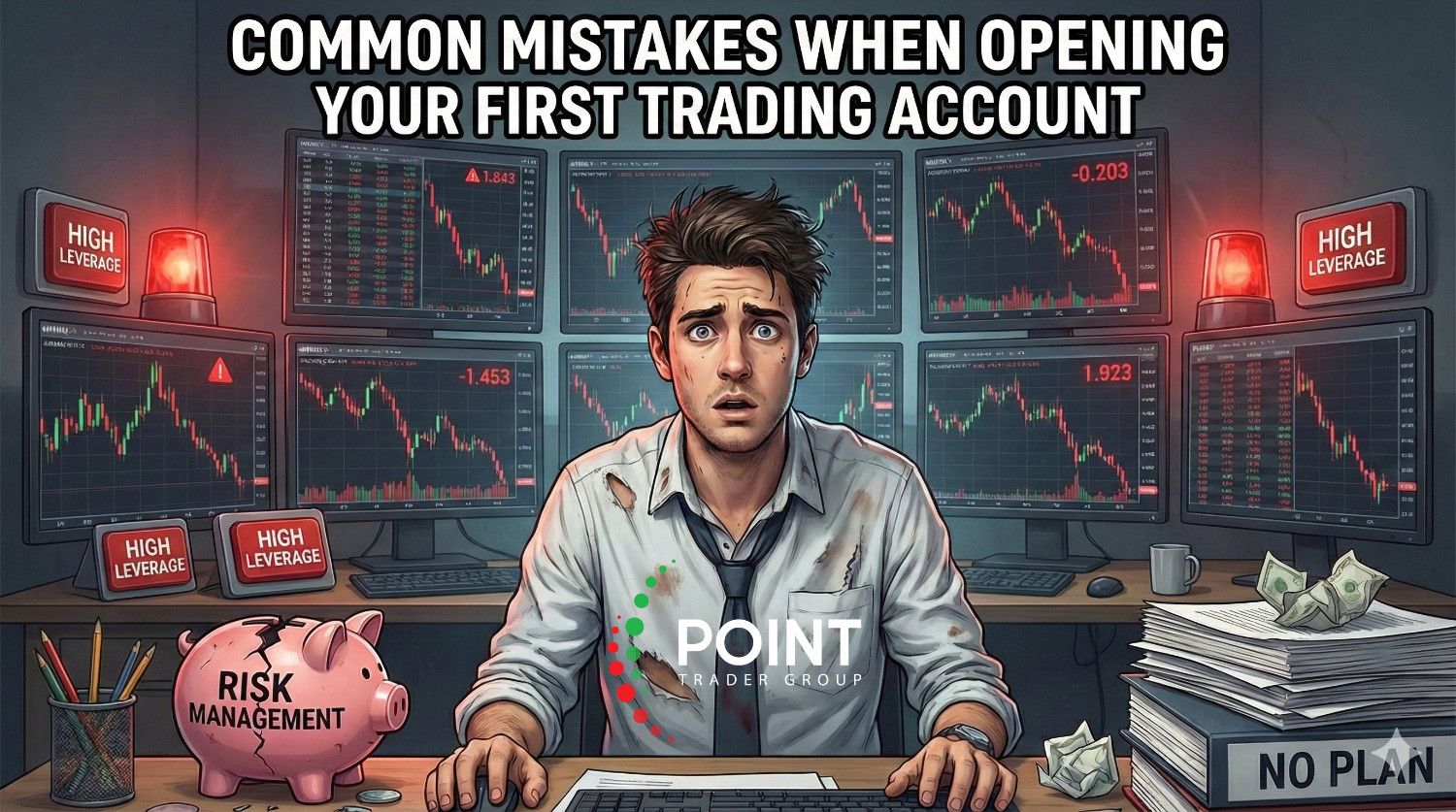
Most traders don’t fail because they lack technical knowledge, but because they make very basic mistakes when opening their first account.
Simple mistakes in form — but devastating in impact.
In this article, we highlight the most common mistakes traders make when opening their first trading account, why they happen, and how to avoid them from day one.
One of the most common mistakes is rushing into a live account without being mentally prepared.
Many beginners believe:
“I’ll learn as I trade.”
The reality is that trading real money introduces psychological pressure unlike anything experienced during training.
Fear, greed, hesitation — all appear suddenly and sabotage even the best strategies.
Solution:
Start with a demo account, not only to learn technical skills, but to practice discipline and decision-making without emotional pressure.
Some beginners fund their first account with a relatively large amount, driven by enthusiasm or overconfidence.
The problem isn’t the amount itself, but the psychological weight:
Increased fear of loss
Hesitation when entering trades
Emotional decision-making
Every dollar becomes a mental burden rather than a trading tool.
Solution:
Start with a very small amount and treat it as a “learning cost,” not an investment.
“Zero spread,” “huge leverage,” “guaranteed profits.”
These phrases are attractive — but they are not valid selection criteria.
Many traders open their first account with the first flashy ad they see, without proper evaluation.
What they overlook:
Execution quality
Withdrawal transparency
Customer support
Overall reliability
Solution:
Choosing a broker should involve:
Checking regulation
Testing a demo account
Reviewing withdrawal policies
Evaluating customer support
One of the most dangerous mistakes is trading without clear risk rules.
Some traders risk a large percentage of their account on a single trade, thinking:
“If I win, I’ll grow fast.”
One loss can wipe out the account entirely.
Solution:
Set a simple rule:
Risk no more than 1–2% per trade
Accept losses as part of the process, not a failure
Beginners often think more trades mean more opportunities.
In reality:
More trades = lower-quality decisions
Mental exhaustion
Loss of focus
Solution:
One or two well-planned trades are better than ten impulsive ones.
The first real loss often shakes beginners badly.
They start questioning:
Is the strategy broken?
Has the market changed?
Am I the problem?
As a result, they jump from one strategy to another without consistency.
Solution:
Any strategy needs a sufficient sample size of trades to be evaluated.
Never judge based on one or two outcomes.
Technical analysis alone is not enough.
Real success in trading starts with managing yourself before managing trades.
Fear and greed are the real enemies — not the market.
Trading without a plan leads to:
Impulsive decisions
Justifying mistakes afterward
No structured learning
Solution:
Even a simple plan is better than none:
Entry rules
Exit rules
Risk limits
When to stop trading
Opening your first trading account is not a test of intelligence — it’s a test of discipline.
Traders who avoid these basic mistakes:
Protect their capital
Learn faster
Build a solid foundation for long-term success
Start slowly.
Learn calmly.
And remember: staying in the market matters more than quick profits.
Get financial advice from Point Trader Group experts.
For free expert financial advice.