Market News:



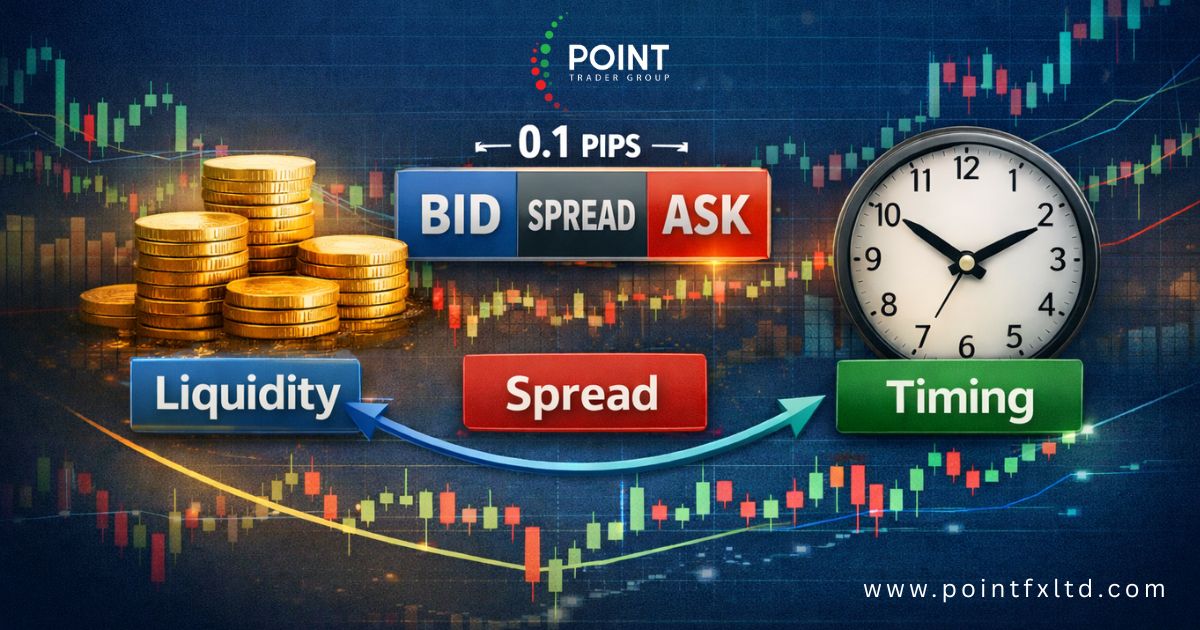
In the forex market, it is not merely the right signal or technical analysis that guarantees a successful trade. Instead, three core factors determine the outcome of any position: liquidity, spread, and timing. A deep understanding of each can completely transform the way you trade.
Liquidity simply refers to the number of buyers and sellers active in the market at a given moment.
The higher the liquidity, the smoother price movement tends to be, with fewer gaps.
The lower the liquidity, the greater the likelihood of unexpected price swings.
In major currency pairs — such as EUR/USD or USD/JPY — liquidity is typically much higher, especially during overlapping market sessions (Asia, Europe, and the U.S.). In contrast, less-traded pairs (cross pairs or exotic pairs) tend to have lower liquidity, which often means higher volatility and more difficulty executing trades smoothly.
The spread is the difference between the bid price and the ask price of a currency pair. The smaller the spread, the lower the cost of entering and exiting a trade.
On trading platforms at Point Trader Group, spreads start from 0.1 pips on major pairs such as EUR/USD.
On other pairs, spreads may be wider due to lower liquidity.
Spreads are not fixed; they fluctuate depending on market liquidity and economic conditions.
Although the forex market operates 24 hours a day, five days a week, activity levels are not equal at all times.
The highest liquidity typically occurs during session overlaps (such as London and New York), when the largest number of market participants are trading simultaneously. During these periods:
Liquidity is higher
Spreads are tighter
Slippage risk is reduced
During quieter periods, entry costs tend to increase, and price movements may take longer to develop in your favor.
Here is the practical takeaway:
High liquidity + Low spread + Proper timing = Greater probability of efficient trade execution.
Low liquidity + Wide spread + Poor timing = Higher risk and potential losses.
A professional forex trader does not rely solely on technical signals. Instead, success depends on understanding how liquidity, spread, and timing interact within the current market environment. Mastering this trio means improving risk management and enhancing long-term performance.
Get financial advice from Point Trader Group experts.
For free expert financial advice.