Gold and Silver Hit Record Highs Amid Monetary Instability and Global Uncertainty
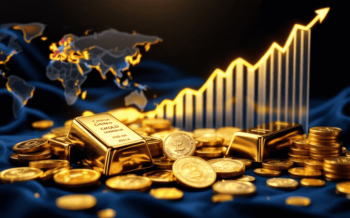
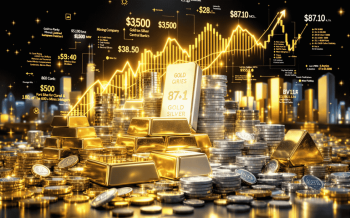
Gold prices recorded a powerful rally during today’s trading session, extending gains from the market open and reaching a new all-time high at $4,640 per ounce. Futures contracts later stabilized near $4,626, marking an impressive daily increase of more than 2.7%. At the same time, spot gold prices surged to approximately $4,630, confirming a broad-based move driven by strong global demand for safe-haven assets.
Silver followed the same bullish trajectory but with even stronger momentum. Silver prices jumped over 7.5%, trading close to $86 per ounce, after registering a historic peak at $86.2. This sharp rise highlights a renewed wave of investment inflows into precious metals, reflecting heightened uncertainty across global financial markets.
Monetary Instability Drives Safe-Haven Demand
The explosive move in gold and silver prices is closely tied to escalating instability within the global monetary environment. Rising institutional tensions, uncertainty around interest rate policy, and growing concerns over the independence of monetary decision-making have collectively undermined investor confidence. As a result, market participants have increasingly reduced exposure to high-risk assets and shifted capital toward gold, silver, and other traditional stores of value.
This shift has been clearly reflected in global equity markets, where European and Asian indices faced notable selling pressure, while expectations for volatile trading sessions in U.S. markets intensified. Meanwhile, the U.S. dollar index came under sustained pressure, further supporting precious metals, which typically benefit from a weaker dollar environment.
Geopolitical Tensions Reinforce the Bullish Outlook
Beyond monetary factors, escalating geopolitical risks have played a central role in reinforcing the upward trend in precious metals. Prolonged regional unrest, expanding protests, and rising political uncertainty have fueled concerns over broader instability, pushing investors toward assets perceived as reliable hedges during periods of crisis.
Reports indicate widespread unrest across multiple cities, accompanied by significant economic and social disruption. Such developments have historically driven strong inflows into gold and silver, as investors seek protection from geopolitical shocks, currency volatility, and potential market dislocations.
Energy Markets and Bond Yields Send Mixed Signals
In contrast to the rally in precious metals, oil prices showed relative weakness, with crude trading near $58.50 per barrel. This decline reflects expectations of increased global supply and easing constraints in certain regions, which has contributed to moderating inflationary pressures. However, the pullback in energy prices has not been sufficient to offset the broader risk-off sentiment dominating financial markets.
At the same time, long-term government bond yields remained relatively stable at elevated levels, signaling caution among investors rather than confidence. This balance suggests markets are pricing in continued uncertainty rather than a clear resolution to ongoing economic and political challenges.
Market Outlook and Strategic Perspective
Looking ahead, analysts expect gold and silver prices to remain supported in the near term, provided monetary uncertainty and geopolitical tensions persist. Elevated volatility across equity, currency, and bond markets continues to favor precious metals as strategic hedging instruments.
Market observers at Point Trader Group note that current price levels may represent the early stages of a broader structural repricing of safe-haven assets, rather than a short-lived speculative spike. In this context, gold and silver are increasingly viewed not only as defensive tools, but also as core components of diversified investment strategies.
As global risks continue to mount, gold remains a critical asset for capital preservation, portfolio diversification, inflation hedging, and risk management, especially in an environment characterized by weakening confidence, elevated volatility, and uncertain economic trajectories.